
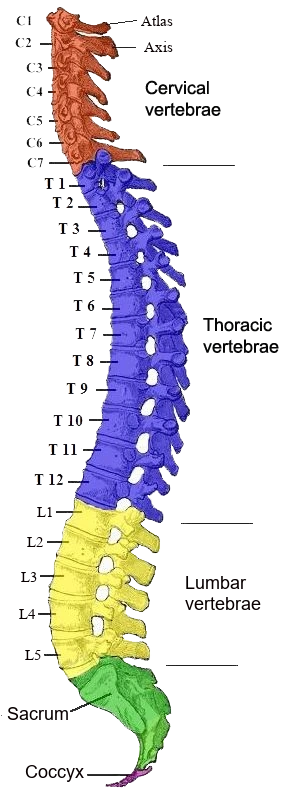
Anatomical overview: the thoracic spine has twelve vertebrae. The image shows the structure of the whole spine, not a pathological change. Original English labels.
Pain between the shoulder blades may arise from muscles, spinal joints or rib joints. Symptoms from other organs may also be felt around the thoracic spine. Careful assessment is therefore important before treating pain as simple muscle tension.
Pain with chest pressure, breathlessness, cold sweats or circulatory problems may be an emergency: call 112. New weakness or severe pain after an accident requires immediate assessment.
Causes and risk factors
Unfamiliar loading and muscle problems are possible causes. Spinal curvature or a vertebral fracture in osteoporosis may also be responsible. Heart and lung conditions can refer pain to this area too.
Typical symptoms
Symptoms may depend on movement or appear after prolonged sitting. Pain linked to breathing, fever, marked night pain or symptoms after a fall require targeted assessment. Severity alone does not reliably distinguish harmless from serious causes.
Diagnosis
History and examination assess the course of pain, movement, breathing and risk factors. Targeted tests are arranged if fracture or another specific cause is suspected. Signs of internal illness lead to appropriate urgent onward care.
Non-surgical treatment
After excluding causes requiring specific treatment, appropriate activity and targeted strengthening often help. Physiotherapy and individually suitable pain relief may supplement care. Persistent deterioration is not simply regarded as a normal training response.
Surgical options
Non-specific symptoms generally do not require surgery. A confirmed vertebral fracture or another structural finding may need specialist advice. Spinal surgery is not promised as one of our own practice services.
Aftercare and rehabilitation
Further care depends on the cause. With muscular symptoms, activity increases gradually. Osteoporosis or fracture care also addresses bone health, fall risk and a coordinated exercise programme.
Common questions
Is pain between the shoulder blades always muscular?
No. Vertebral fractures and heart or lung conditions can also cause pain there.
Do I need an X-ray?
That depends on the examination and suspected diagnosis, for example a suspected fracture.
Can osteoporosis be involved?
Yes. Reduced bone density can allow a vertebral fracture after relatively minor loading.
Arrange a consultation
We discuss which treatment is suitable for your findings and which procedures are available within our outpatient service during a personal consultation. Outpatient operations take place at an external surgical centre.
Choose location & appointment →Our services →Explore the topic
Further reading
Selected external resources about this condition. Some linked publications are in German.
Medical background
Sources & further information
These professional and patient resources provide further information about this condition. The text on this page is independently written.
University Medical Center Freiburg: Back pain