
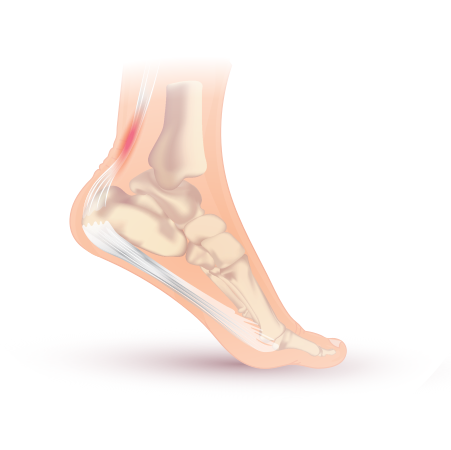
The Achilles tendon connects the calf muscles to the heel bone. The highlighted area shows a typical location of overuse symptoms along the tendon.
The Achilles tendon transfers calf muscle force to the foot. It carries substantial loads during walking, running and jumping. Persistent problems are often called tendinopathy and affect either the attachment to the heel bone or the middle part of the tendon. Treatment depends on location and tolerance of loading. A sudden rupture is different and needs prompt examination.
A sudden snapping sensation with weakness or suspected tendon rupture needs prompt examination. New painful calf swelling or breathlessness requires urgent assessment.
Causes and risk factors
A rapid increase in running distance, jumping or hill running can overload the tendon. Reduced calf strength, changing training conditions and individual anatomical factors may contribute. Some medicines and medical conditions affect the tendon; these are considered in the history. Tendinopathy is not simply short-lived inflammation. Adaptation takes time, so carefully graded training is usually more important than repeated complete rest or purely passive measures.
Typical symptoms
Morning pain and stiffness, tenderness and symptoms during or after activity are common. The tendon may be thickened. Shoe pressure can worsen pain at the attachment. A sudden snapping sensation with marked weakness, a palpable gap or inability to push off may indicate rupture. Walking can still be possible despite a tear, so this cannot be excluded on walking ability alone.
Diagnosis
We examine the painful area, calf strength, walking and foot function. Specific functional tests are used if a tear is suspected. Ultrasound can show tendon structure and continuity; MRI is used for selected unresolved questions. X-rays may show bone changes where insertional pain occurs. Images are compared with symptoms and function. Tendon thickening alone says little about tolerable everyday or sporting activity.
Non-surgical treatment
Individually graded strength and loading exercises are central. The amount and technique differ for insertional and mid-tendon problems. Running and jumping are adjusted; alternatives can maintain activity. Temporary heel lifts or suitable shoes help some people. Shockwave therapy may be considered as an addition for certain chronic cases, but success is not guaranteed. Injections near the tendon require particular caution and careful consideration of benefits and risks.
Surgical options
For chronic symptoms, surgery is considered only after sufficiently consistent conservative treatment and reassessment of the diagnosis. A recent rupture may be treated with functional non-surgical care or surgery depending on the findings, risks and activity goals. We discuss options and coordinate specialist assessment where necessary. A general treatment description does not promise that every procedure is included in our own outpatient surgical service. Decisions follow examination.
Aftercare and rehabilitation
Rebuilding capacity often takes several months. Calf strength, endurance and the response the next day matter. After rupture, a specific protection and mobilisation plan is followed, often using a special brace. Ankle position and loading must not be advanced without guidance. Return to running and jumping depends on functional criteria. Temporary worsening during training should be discussed, particularly if strength or walking ability declines substantially.
Common questions
Should I stop all activity when it hurts?
Targeted adjustment is often better than prolonged complete rest. The right level is determined through examination and follow-up.
Do stretching exercises always help?
No. Strong stretching can irritate the tendon, particularly at its attachment. Exercises should suit the location.
When can I run again?
When walking and strength exercises are sufficiently well tolerated and the tendon responds well to progression. There is no date that applies to everyone.
Arrange a consultation
We discuss which treatment is suitable for your findings and which procedures are available within our outpatient service during a personal consultation. Outpatient operations take place at an external surgical centre.
Choose location & appointment →Our services →Other conditions in this region
Explore the topic
Further reading
Selected external resources about this condition. Some linked publications are in German.
Medical background
Sources & further information
These professional and patient resources provide further information about this condition. The text on this page is independently written.
AAOS: Achilles tendinitis