
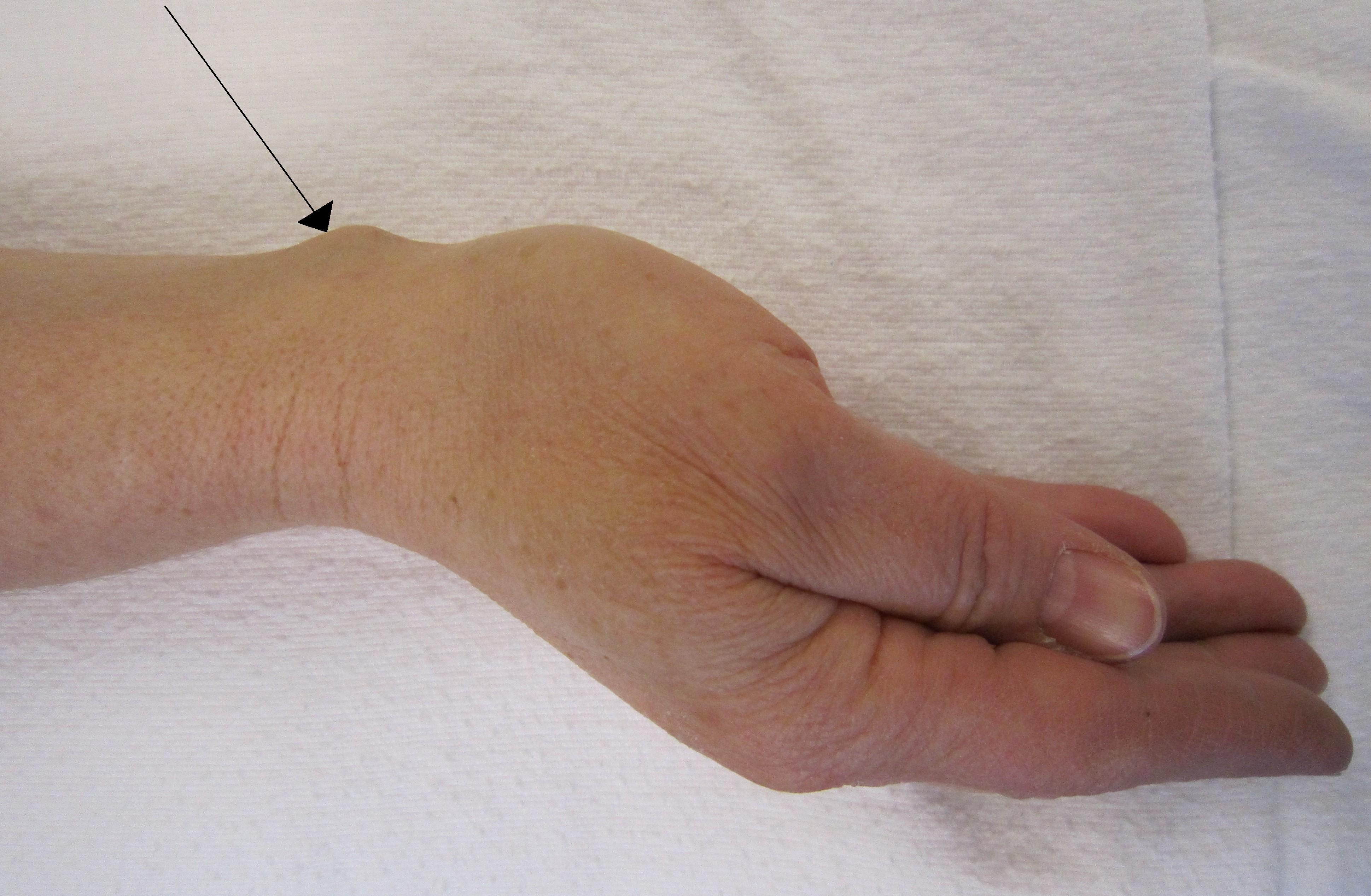
A ganglion may appear as a localised swelling at the wrist. This clinical example photograph shows a ganglion on the back of the wrist.
A ganglion is a benign fluid-filled swelling near a joint or tendon sheath. It commonly occurs at the wrist, but also on fingers or the foot. The German everyday term “Überbein” is misleading: this is not newly grown bone. Not every ganglion needs treatment. First we establish whether the swelling really is a ganglion and whether it causes pain or functional problems.
A rapidly growing, hard or poorly mobile swelling should be assessed promptly. Marked redness, warmth and pain may indicate inflammation or infection.
Causes and risk factors
The exact cause is not always known. There is often a connection to the joint capsule or tendon sheath. Activity may affect its size; some ganglia are barely visible at times. Previous injury may contribute but is not necessary. On the foot, tight footwear can worsen symptoms. Do not diagnose a new swelling by appearance alone, particularly if it grows quickly or feels unusually firm.
Typical symptoms
A smooth lump of varying firmness is typical. It may be painless or troublesome with movement and pressure. Wrist ganglia sometimes hurt when bearing weight through the hand; shoe pressure may be the main problem on the foot. A ganglion near a nerve can cause tingling or numbness. Size and symptoms do not necessarily correspond: a small deep ganglion may hurt while a visible one causes little limitation.
Diagnosis
We assess its location, consistency, mobility and the affected joint's function. Ultrasound can distinguish fluid-filled from solid changes and show nearby vessels or nerves. Further imaging may be needed for unclear or deep swellings. X-rays may help identify bone changes. If the diagnosis is uncertain, appropriate assessment is planned before removal; not every lump should be punctured without a clear diagnosis.
Non-surgical treatment
A confirmed ganglion causing little trouble may be observed and occasionally shrinks. Adjusting activity or temporary support can ease symptoms. Aspiration is an option for selected ganglia, although recurrence is common. Particular caution is needed near blood vessels. Do not puncture, squeeze or hit a ganglion yourself: this can injure skin, vessels or other structures and cause infection.
Surgical options
Removal may help with persistent pain, functional limitation or pressure on nearby structures. Depending on its location, the connection to the capsule or tendon sheath is also addressed. Ganglion removal from the hand and foot is among our selected outpatient procedures at the external surgical centre. Recurrence is possible even after surgery. Scar discomfort, stiffness and nerve or vessel injury are discussed individually beforehand.
Aftercare and rehabilitation
Wound checks, swelling management and appropriate movement are the initial priorities. Whether and how long a splint or special shoe is useful depends on the location and procedure. Pressure loading increases gradually. A wrist or foot scar may initially be sensitive. Targeted therapy may help persistent stiffness. A new lump after healing is assessed again and does not automatically indicate a dangerous change.
Common questions
Is a ganglion dangerous?
A confirmed ganglion is benign. New or uncertain lumps should nevertheless be examined.
Can it return after removal?
Yes. The risk depends in part on location and technique.
Can a ganglion occur on the foot?
Yes. Shoe pressure in particular may cause pain. Assessment and treatment depend on the exact location.
Arrange a consultation
We discuss which treatment is suitable for your findings and which procedures are available within our outpatient service during a personal consultation. Outpatient operations take place at an external surgical centre.
Choose location & appointment →Our services →Other conditions in this region
Explore the topic
Further reading
Selected external resources about this condition. Some linked publications are in German.
Medical background
Sources & further information
These professional and patient resources provide further information about this condition. The text on this page is independently written.
NHS: Ganglion cystAAOS: Ganglion cyst