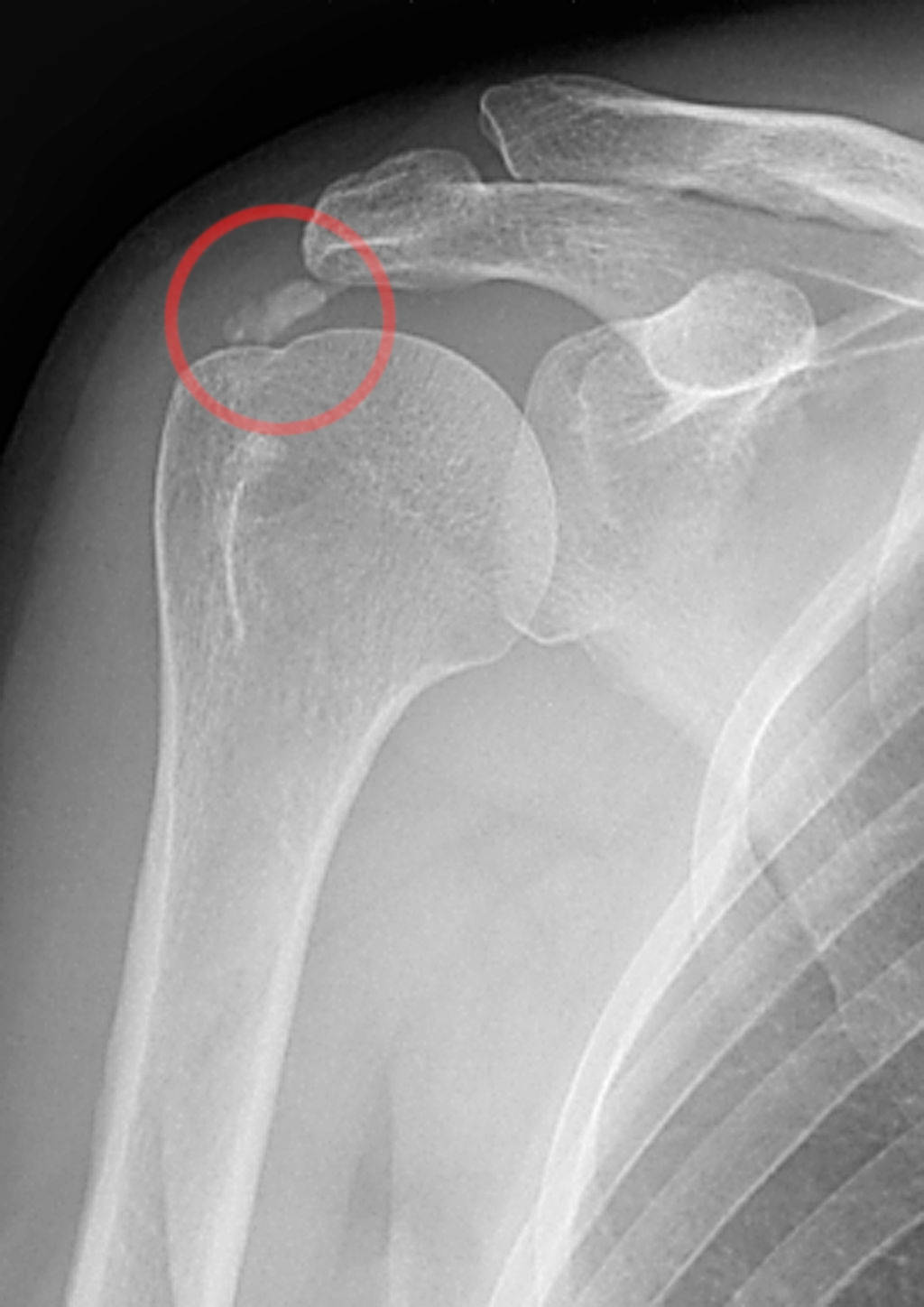
Example of calcific tendinopathy on an X-ray: the circle marks a calcium deposit in the rotator cuff region. Imaging findings are assessed alongside the symptoms.
In calcific tendinitis, calcium deposits develop within the rotator cuff tendons. They may go unnoticed or cause considerable pain. The shoulder can become suddenly very painful, particularly while a deposit is being broken down.
Fever, a hot, red shoulder or sudden loss of strength after injury requires prompt examination.
Causes and risk factors
The exact cause is not fully understood. Changes within the tendon play a role. A calcium deposit does not automatically mean a tendon tear and is not simply caused by too much calcium in the diet.
Typical symptoms
Pain on the side of the shoulder, night pain and pain when lifting the arm can occur. In an acute phase, any movement may be difficult. Some deposits, however, cause no symptoms at all.
Diagnosis
Examination, X-rays and sometimes ultrasound help assess the deposit and tendon. Whether these findings match the symptoms is crucial. MRI is used for additional questions, not automatically for every calcium deposit.
Non-surgical treatment
Initially, treatment focuses on appropriate movement and pain relief. Physiotherapy and selected additional treatments can be discussed if symptoms persist. Shockwave therapy or specialist needle-based treatment is not suitable for every case; the evidence and possible risks are weighed up.
Surgical options
For persistent, significant symptoms after conservative treatment, a shoulder specialist may assess whether surgery is appropriate. Shoulder arthroscopy is not part of our current operative service. We support the assessment and coordinate further care when needed.
Aftercare and rehabilitation
Once severe pain settles, movement and load tolerance are rebuilt gradually. Prolonged complete immobilisation is usually unhelpful. After an external surgical procedure, rehabilitation depends on the technique used and any tendon treatment.
Common questions
Does every calcium deposit need removing?
No. Deposits without symptoms often need no treatment and may also resolve on their own.
Is shockwave therapy guaranteed to help?
No benefit can be guaranteed. Suitability, uncertainties, risks and costs are discussed individually.
Arrange a consultation
We discuss which treatment is suitable for your findings and which procedures are available within our outpatient service during a personal consultation. Outpatient operations take place at an external surgical centre.
Choose location & appointment →Our services →Other conditions in this region
Explore the topic
Further reading
Selected external resources about this condition. Some linked publications are in German.
Medical background
Sources & further information
These professional and patient resources provide further information about this condition. The text on this page is independently written.
AAOS: Calcific tendinitis of the shoulderNICE: Shockwave therapy for calcific shoulder tendinopathy