
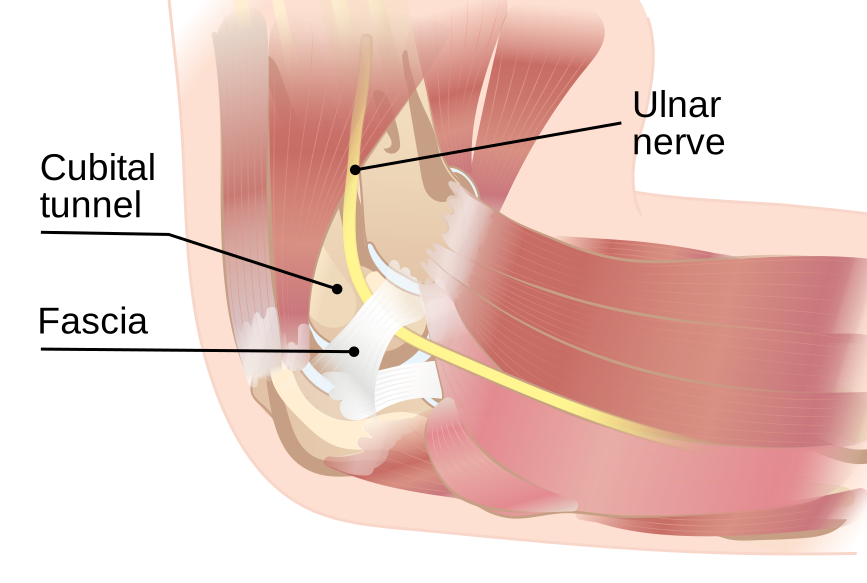
The ulnar nerve passes through the cubital tunnel on the inner side of the elbow, where it can become compressed. Original English labels.
Cubital tunnel syndrome involves irritation or compression of the ulnar nerve on the inner side of the elbow. It supplies sensation to the little finger and part of the ring finger and controls important hand muscles. Symptoms are often noticed when the elbow stays bent for a long time. Treatment aims to reduce pressure and preserve nerve function. Increasing weakness needs prompt assessment because longstanding damage may not fully reverse.
Increasing hand-muscle weakness, visible wasting or persistent numbness should be examined promptly. Sudden weakness of the whole arm with speech or facial changes is an emergency: call 112.
Causes and risk factors
The nerve runs close to the surface in a narrow channel at the elbow. Prolonged pressure from leaning, frequent deep bending or changes after injury can encourage irritation. In some people the nerve moves out of its groove when the elbow bends. Bone changes may also contribute. Not all little-finger tingling originates at the elbow; compression at the wrist or neck problems can also be responsible.
Typical symptoms
Tingling and numbness in the little and ring fingers are typical, for example at night, while phoning or driving. Inner-elbow pain may occur. Later, spreading the fingers may become difficult, fine movements weaker and grip less secure. Muscle wasting between the metacarpal bones is an important sign of advanced involvement. Pain treatment alone is then insufficient; nerve function needs targeted assessment.
Diagnosis
We assess sensation, hand strength, fine movements and the nerve's course at the elbow. The neck, shoulder and wrist are included as appropriate. Nerve conduction testing helps identify the site and severity of damage. Ultrasound can show compression or movement of the nerve. Further imaging may be used if bone or other changes are suspected. Findings are assessed together, since no single test resolves every situation.
Non-surgical treatment
For mild symptoms, avoiding pressure on the elbow and reducing prolonged deep bending may help. Suitable positioning or a splint at night can provide support. Workstations and triggering tasks are adjusted. Selected guided exercises may help but should not repeatedly irritate the nerve. Persistent numbness or weakness needs follow-up. Progressive nerve damage must not be overlooked through indefinite waiting or pain medication alone.
Surgical options
If pressure-relieving measures are insufficient or significant damage is present, surgery can create more room for the nerve. Decompression is used, with relocation in selected cases according to its course and stability. Treatment of cubital tunnel syndrome is among our selected procedures at the external surgical centre; the precise technique depends on the findings. Longstanding muscle weakness may remain despite technically successful decompression. This is explained before deciding.
Aftercare and rehabilitation
After surgery, the wound, elbow movement and nerve function are checked. Loading restrictions depend on the procedure. Pressure on the operated area and heavy repetitive loading are initially avoided. Tingling may improve before strength and sensation recover. Nerves recover slowly; a reliable outcome cannot be judged after a few days. Hand therapy and an adapted exercise programme can support a return to everyday tasks.
Common questions
Which fingers are affected?
Typically the little finger and the little-finger side of the ring finger. Other patterns may suggest another cause.
Does keeping the elbow straighter at night help?
It may help mild symptoms. Suitable positioning is explained individually.
Does the nerve recover immediately after surgery?
Not always. Longstanding sensory and strength problems take time and may partly persist.
Arrange a consultation
We discuss which treatment is suitable for your findings and which procedures are available within our outpatient service during a personal consultation. Outpatient operations take place at an external surgical centre.
Choose location & appointment →Our services →Other conditions in this region
Explore the topic
Further reading
Selected external resources about this condition. Some linked publications are in German.
Medical background
Sources & further information
These professional and patient resources provide further information about this condition. The text on this page is independently written.
AAOS: Ulnar nerve entrapment