
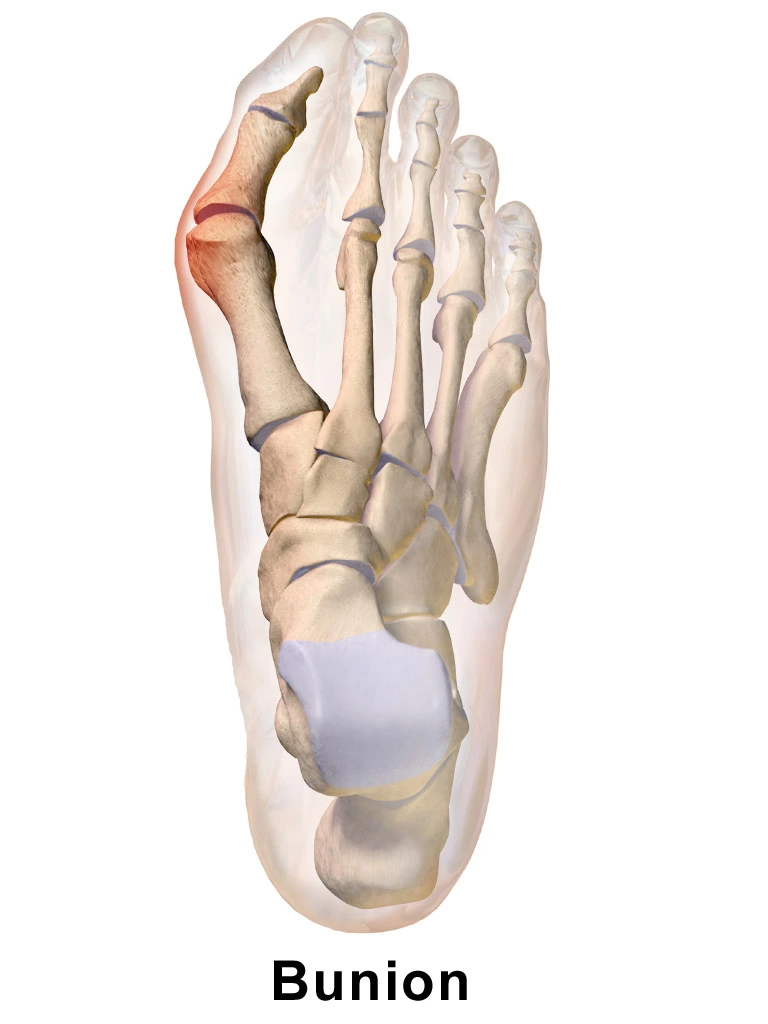
The big toe angles towards the smaller toes, while the bunion projects from the inner edge of the foot. Original English labels.
In hallux valgus, the big toe angles towards the smaller toes and a bunion projects from the inner forefoot. Treatment is based on pain and difficulty walking, not appearance or an X-ray angle alone.
An open pressure sore, increasing redness or warmth should be examined early, particularly in people with diabetes.
Causes and risk factors
Foot shape and family history play a role. Tight shoes can increase pressure and discomfort. Inflammatory joint conditions and altered loading patterns may also contribute.
Typical symptoms
The bunion often hurts inside shoes. Pressure marks, red skin and pain when rolling through the foot can occur. Neighbouring toes may be displaced. Additional osteoarthritis of the big toe joint can restrict movement.
Diagnosis
The foot is examined while sitting, standing and walking. We assess joint movement, pressure points and the other toes. Weight-bearing X-rays help assess the deformity and possible joint damage before deciding about surgery.
Non-surgical treatment
Wide shoes with enough toe room and targeted pressure relief are the initial priorities. Insoles may relieve associated load-related pain, but cannot permanently straighten a pronounced bony deformity. Pain medication may be considered when needed, taking tolerability into account.
Surgical options
If significant pain persists despite appropriate conservative measures, surgical correction of the bones may be helpful. The technique depends on the deformity and the condition of the joint. Surgery for purely cosmetic reasons is not recommended. We advise on whether surgery is appropriate and refer to specialist foot surgery when necessary.
Aftercare and rehabilitation
After surgery, individual instructions apply to weight-bearing, dressings and footwear. Swelling may persist for some time. Walking distance and sporting activity are increased gradually; follow-up appointments also assess bone healing.
Common questions
Do insoles help?
They can redistribute pressure and relieve pain. They are not expected to permanently correct the position of the big toe.
When is surgery appropriate?
An individual surgical consultation may be helpful when pain limits everyday life and suitable shoes and pressure relief do not provide sufficient benefit.
Arrange a consultation
We discuss which treatment is suitable for your findings and which procedures are available within our outpatient service during a personal consultation. Outpatient operations take place at an external surgical centre.
Choose location & appointment →Our services →Other conditions in this region
Explore the topic
Further reading
Selected external resources about this condition. Some linked publications are in German.
Medical background
Sources & further information
These professional and patient resources provide further information about this condition. The text on this page is independently written.
AAOS: Bunions