
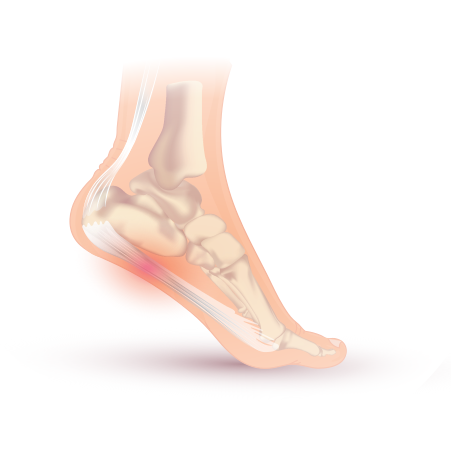
The highlighted area shows the plantar fascia and its typical pain location beneath the heel. The illustration does not depict a bony heel spur.
Pain beneath the heel often arises at the attachment of the plantar fascia, a strong band of connective tissue in the sole. A heel spur visible on X-ray may coexist but is often an incidental finding. Treatment therefore addresses the symptoms, not the spur alone.
After an injury, or with inability to bear weight, marked redness or fever, the heel should be assessed promptly.
Causes and risk factors
A rapid increase in running or standing, reduced calf flexibility and unfavourable loading patterns can overload the attachment. Several factors may interact; a single trigger cannot always be identified.
Typical symptoms
A sharp pain with the first steps in the morning or after prolonged sitting is typical. It may ease after walking briefly, then worsen with longer activity. The tender point is usually on the inner underside of the heel.
Diagnosis
A discussion and examination are often sufficient. We assess tenderness, foot mobility and loading patterns. Atypical or persistent symptoms prompt investigation for other causes, such as a stress fracture. Not every case of heel pain needs imaging.
Non-surgical treatment
Adjusting activity, suitable shoes, stretching and strengthening form the basis of treatment. Insoles or heel pads may provide additional relief. Shockwave therapy may be considered for persistent symptoms after weighing the options. Improvement is not guaranteed with this treatment either.
Surgical options
Surgery is considered only rarely, when a sufficiently long course of conservative treatment has not helped and the diagnosis is established. A visible spur alone does not justify removal. Specialist assessment is arranged when needed.
Aftercare and rehabilitation
Recovery often requires patience. Walking and training are increased in stages rather than alternating between complete rest and maximum activity. An exercise plan should fit everyday life and be reviewed if symptoms continue to worsen.
Common questions
Is the spur causing the pain?
Not necessarily. Many people have heel spurs without pain; an overloaded plantar fascia is often the main issue.
Can I keep running?
Activity should be adjusted so that symptoms do not continue to worsen. Other forms of exercise may be helpful temporarily.
Arrange a consultation
We discuss which treatment is suitable for your findings and which procedures are available within our outpatient service during a personal consultation. Outpatient operations take place at an external surgical centre.
Choose location & appointment →Our services →Other conditions in this region
Explore the topic
Further reading
Selected external resources about this condition. Some linked publications are in German.
Medical background
Sources & further information
These professional and patient resources provide further information about this condition. The text on this page is independently written.
gesund.bund.de: Heel spursAAOS: Plantar fasciitis