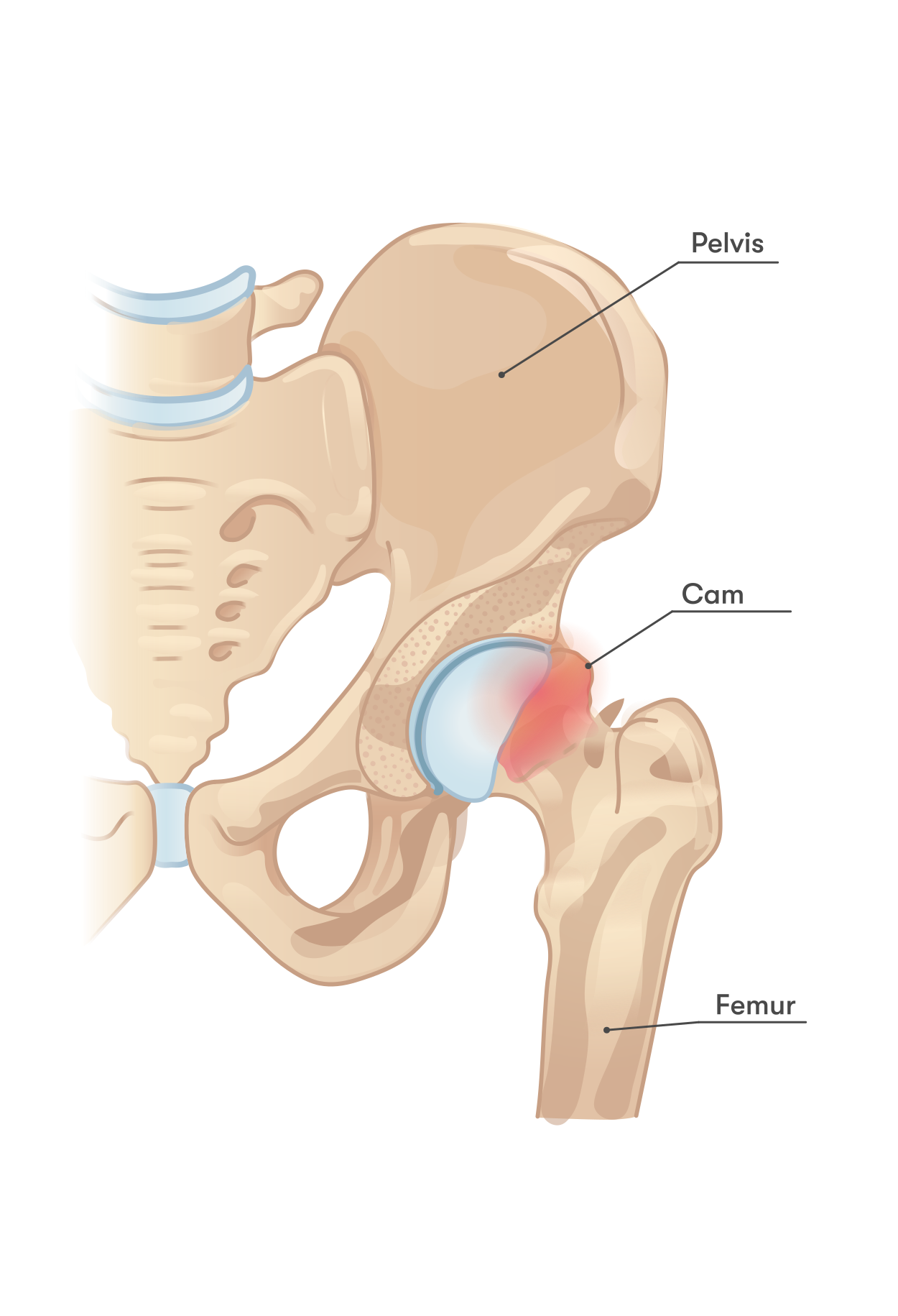
The image shows cam-type hip impingement: an altered bone shape can contact the socket rim during movement. Original English labels.
In femoroacetabular impingement, variations in the shape of the junction between the femoral head and neck, or of the hip socket, can lead to painful contact. Not every such bone shape causes symptoms. For a syndrome that requires treatment, symptoms, examination and imaging must be consistent.
Inability to bear weight after a fall, fever or severe sudden hip pain requires urgent assessment.
Causes and risk factors
A cam shape affects the head-neck junction, while a pincer shape concerns coverage by the socket. Repeated deep bending may trigger symptoms with these shapes. Cartilage and the labrum, the rim of the socket, may also be affected.
Typical symptoms
Groin pain commonly occurs during deep sitting, bending or twisting. There may be stiffness or painful clicking. However, similar symptoms can also originate from tendons, the back or other conditions.
Diagnosis
We assess hip movement, walking and movements that trigger pain. X-rays show the bone shapes. MRI may assess cartilage and the labrum when appropriate. Imaging is always compared with the clinical examination.
Non-surgical treatment
Activity adjustments and targeted exercise for the hip and trunk muscles can improve function. Repeated forced bending into a painful end range is initially avoided. Medication may provide short-term support if suitable.
Surgical options
For persistent symptoms with matching structural findings, hip-preserving surgery in a specialist centre may be considered. Advanced osteoarthritis affects the chance of success and choice of procedure. Hip arthroscopy is not promised as a service performed by this practice.
Aftercare and rehabilitation
Everyday activities and sport are adjusted gradually. After surgery, protection periods vary depending on any cartilage or labral treatment. Return to sport should follow function and the medical rehabilitation plan.
Common questions
Does a cam shape need surgery?
No. A shape variation without corresponding symptoms is not automatically a reason for surgery.
Can I keep training?
Modified training is often possible. Painful deep bending and twisting should initially be reduced, with an individual plan for progression.
Arrange a consultation
We discuss which treatment is suitable for your findings and which procedures are available within our outpatient service during a personal consultation. Outpatient operations take place at an external surgical centre.
Choose location & appointment →Our services →Other conditions in this region
Explore the topic
Further reading
Selected external resources about this condition. Some linked publications are in German.
Medical background
Sources & further information
These professional and patient resources provide further information about this condition. The text on this page is independently written.
AAOS: Femoroacetabular impingement