
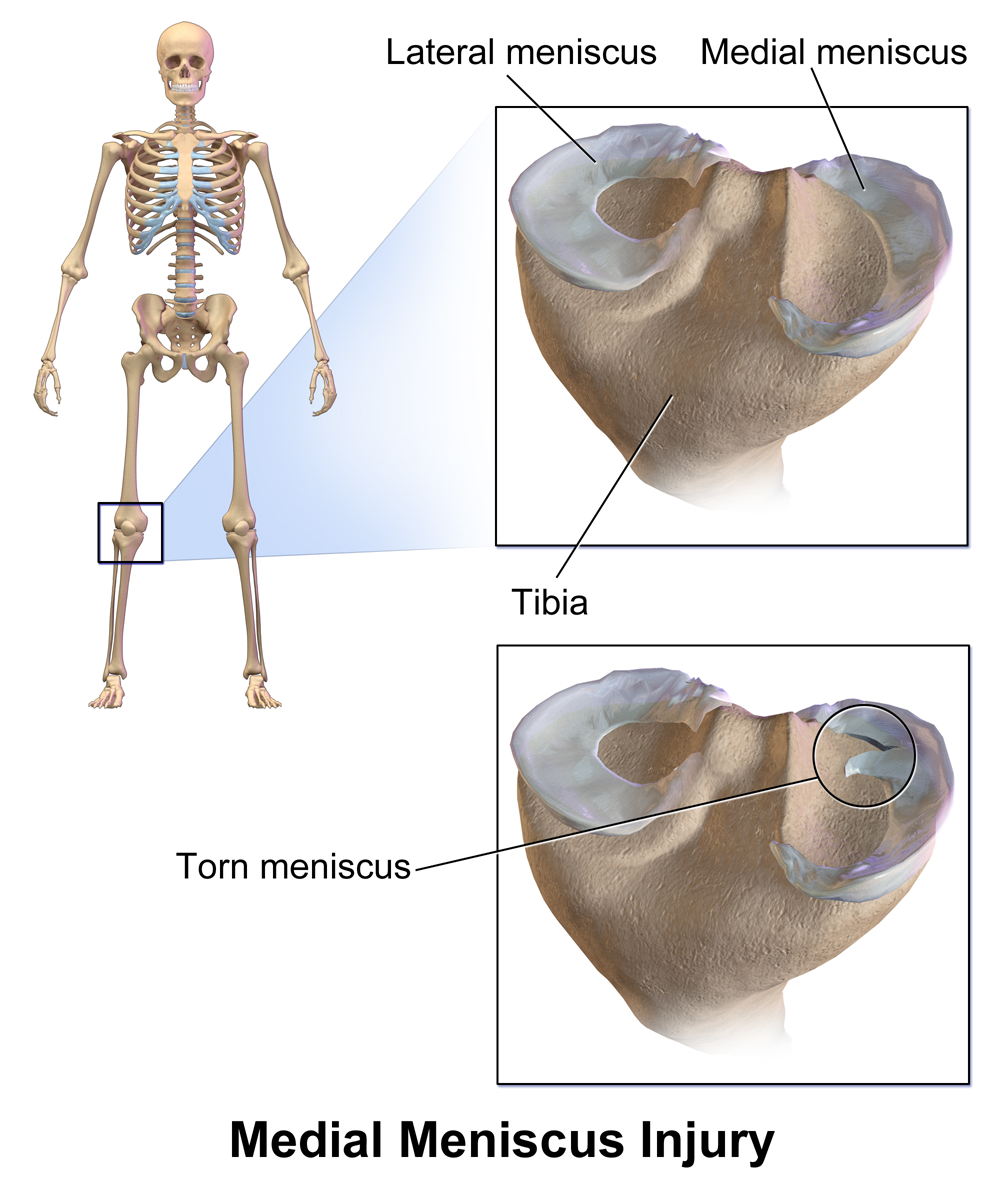
The detail views show the menisci on the upper surface of the shin bone. An example of a tear in the medial meniscus appears below. Original English labels.
The two menisci distribute load between the thighbone and shinbone and help stabilise the knee. A tear can follow a twisting injury or develop over many years. This distinction matters for treatment: a recent traumatic tear is assessed differently from a degenerative finding on MRI. Symptoms, movement, tear pattern and associated injuries are decisive. An abnormal image alone does not justify surgery.
A locked knee, obvious deformity or rapidly increasing swelling after an accident needs prompt medical assessment. A hot, red knee with fever requires urgent examination.
Causes and risk factors
Rapid changes of direction, sudden stops and twisting a weight-bearing knee during sport can injure the meniscus. An unstable knee following a cruciate ligament injury increases the risk of further damage. With age, the meniscus changes in structure and resilience; everyday movements may then reveal a tear. These degenerative changes often occur alongside osteoarthritis and do not necessarily cause symptoms.
Typical symptoms
Typical symptoms include pain along the inner or outer joint line, pain with deep bending or twisting, and swelling. Some people describe clicking or a feeling that something catches inside the joint. A displaced fragment can prevent full straightening. Other knee conditions cause similar symptoms. A genuinely locked knee after an injury should therefore be assessed promptly rather than forcibly straightened.
Diagnosis
We ask about the injury, when symptoms began and previous activity levels. We then assess the joint line, swelling, movement and ligament stability. MRI is particularly helpful for unclear findings, associated injuries or surgical planning. X-rays do not show the meniscus but may reveal arthritis or bone injuries. Imaging is always compared with the examination: not every tear reported on MRI explains the pain.
Non-surgical treatment
Without mechanical locking, a targeted trial of non-surgical treatment may be appropriate. Initially, adjusted activity and sometimes short-term pain relief can help; strength, movement and coordination then become the focus. Physiotherapy supports a gradual return to loading. Exercise therapy is usually the main treatment for degenerative tears. Prolonged rest weakens the muscles. Medication is selected with other medical conditions and tolerability in mind; it does not replace exercise.
Surgical options
Surgery may be considered for selected acute tears, persistent mechanical symptoms or locking. Meniscal tissue should be preserved whenever possible. Depending on the tear's location and tissue quality, options include repair or limited removal of unstable fragments. Routine arthroscopy for degenerative symptoms usually offers no additional benefit. Following a personal examination, we discuss which selected knee procedures can be performed at the external surgical centre.
Aftercare and rehabilitation
Aftercare depends on the procedure. Meniscal repair often requires a longer period of protection and more restrictions on weight-bearing and bending than partial removal. Wound checks, swelling management and gradual strengthening support recovery. Return to sport depends on function, strength and the knee's response to activity. A general timetable cannot replace this assessment. Regular exercise remains beneficial even after successful treatment.
Common questions
Does every meniscus tear need surgery?
No. Degenerative tears in particular are often treated without surgery. Tear pattern, locking and associated injuries influence the decision.
Can I continue exercising?
This depends on pain, swelling and stability. Twisting activities should initially be adjusted, with a gradual return to sport.
Why do MRI findings and pain sometimes not match?
Meniscal changes are common even in people without symptoms. Examination and symptoms are therefore just as important as the image.
Arrange a consultation
We discuss which treatment is suitable for your findings and which procedures are available within our outpatient service during a personal consultation. Outpatient operations take place at an external surgical centre.
Choose location & appointment →Our services →Other conditions in this region
Explore the topic
Further reading
Selected external resources about this condition. Some linked publications are in German.
Medical background
Sources & further information
These professional and patient resources provide further information about this condition. The text on this page is independently written.
IQWiG: Meniscus tearsIQWiG: TreatmentAAOS: Meniscus tears